
Can Marketing Performance Be Connected to Revenue?
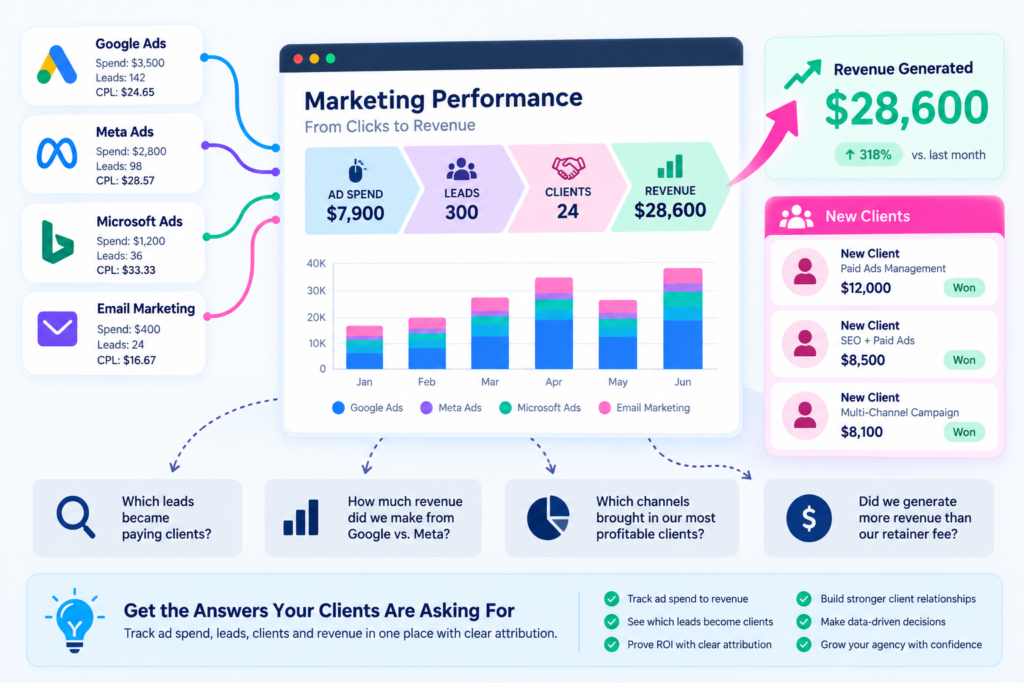
If a client asked you today "We spent $3,500 on Google last month - how much revenue did we generate?" What would you say?
How about these questions:
1.) “Which leads from our Search campaign became paying clients?”
2.) “How much did it cost to acquire a customer last month from our Meta Ads?”
3.) “Which marketing channels brought in our most profitable customers this quarter?”
4.) “How much revenue did we make from Google vs Meta?”
5.) “Is the additional revenue your agency generated for us this month more or less than what we pay you for your retainer?”
If you can’t answer these questions and you are tired of being asked them without a reliable solution – you are not alone.
The Difference Between Reporting Leads and Proving Revenue
The ad platforms give you what you spent, how many leads were generated and what the cost per lead is for that time period. What it does not give you is:
- How many touch points prior to clicking on the clients’ ad did the customer interact with the client’s Social Media, Email Marketing and SEO BEFORE they became a paying customer?
- How much revenue the client earned from that paying customer?
- Is the client getting a return on their investment with your agency?
That’s the difference and that is what the clients are now asking for. Now they want to know:
- “How do you attribute the work that your agency did to my bottom line?”
- “Where is my budget the most effective when spent on these marketing channels that I pay you to manage for me?”
- “Why are the costs of my ads rising?”
- “How many new customers will I get if I increase my ad spend budget?”
- “How reliable is the reporting data in your dashboard that you send me?”
- “Why are my leads falling flat and not turning into paying customers?”
What Traditional Paid Ads Reporting Lacks
Most of the reporting software out there does not include a clear picture of which marketing channel and specific ad or piece of content influenced revenue growth. And this is the main issue that has been plaguing digital marketing agencies since the implementation of ad platform automation. The traditional ad platform dashboard and even 3rd party SaaS tools are not offering this insight that the agencies so desperately need in order to prove their value to their clients.
Where Traditional Reporting Gaps Are
Attribution tracking stops at the lead submission. This leaves the client and your agency to guess which leads came from which ad and generated how much ROAS. The CRMs do not retain ad-source identifiers on their own, so you need a custom built dashboard for this typically. Offline sales are not automatically recorded in CRMs, there is an extra external step that needs to occur in order for this to be reported correctly. Even Google Analytics/GA4 uses a attributed conversions model rather than an individually observed event.
How Attribution Changes Your Reporting and Answers All of Your Client's Questions
Proper attribution like Fischer SEM’s proprietary software allows your agency to track the ad spend along with the leads generated, the total number of qualified leads and how many actual paying customers that were acquired from those leads. From there, the client’s revenue can be displayed and your agency can answer all of the questions we went over in this article. This leaves your client happy, profitable and your agency with consistent MRR plus an excellent track record to take to new clients so that you can grow your agency.